
How Long Does Kombucha Take to Ferment?
Every kombucha recipe gives you a number. Seven days. Ten days. Two weeks. And then you make your first batch, taste it on the day the recipe says it should be ready, and it tastes nothing like the kombucha you’ve had before.
The honest answer to “how long does kombucha take to ferment” is: it depends, and the recipe’s number is a starting point rather than a deadline.
This post explains what actually determines fermentation time, gives you realistic ranges for different conditions, and shows you how to find your own timing rather than relying on someone else’s.
The Short Answer
For first fermentation, 7 to 14 days is the typical range at room temperature. Most batches fall somewhere in the middle, around 9 to 12 days.
For second fermentation (bottled, flavoured), 2 to 5 days is typical.
These ranges are wide because fermentation time depends heavily on factors specific to your setup: temperature, SCOBY activity, sugar amount, and starter liquid quantity. The same recipe can take 7 days in one kitchen and 14 in another.
What Actually Determines Fermentation Time

Temperature — the biggest factor by far
Temperature has a larger effect on fermentation time than almost anything else. The bacteria and yeast in your SCOBY are more active at higher temperatures and slower at lower ones (Jayabalan et al., 2014).
Below 20°C: Fermentation slows significantly. A batch that would take 9 days at 24°C might take 14–16 days at 18°C.
21–27°C: The ideal range. Most recipes are written assuming temperatures in this range, which is why a 7–10 day estimate is common.
Above 28°C: Fermentation speeds up considerably. A batch that takes 10 days at 24°C might be ready in 5–6 days at 30°C. There’s a risk at the upper end, though. Very high temperatures can stress the culture and favour less desirable organisms.
If your kitchen temperature varies seasonally — colder in winter, warmer in summer — your fermentation time will vary too, sometimes by a week or more between the same recipe in January versus July.
SCOBY activity and age

A young, newly acquired SCOBY often ferments more slowly than an established one, especially in its first few batches as it adjusts to your specific tea, sugar and water. A mature, well-fed SCOBY that’s been through many batches tends to ferment more quickly and consistently.
This means your fermentation time may genuinely change over your first several batches, not because anything is wrong, but because your culture is settling in.
Starter liquid quantity
More starter liquid means the new batch starts more acidic, which can mean a head start toward the flavour profile you’re aiming for. 100–200ml per litre is standard. Significantly more than this can shorten the time needed to reach a tangy flavour, though it can also mean reaching over-fermentation more quickly too — see my post on why kombucha tastes like vinegar for more on this.
Sugar amount
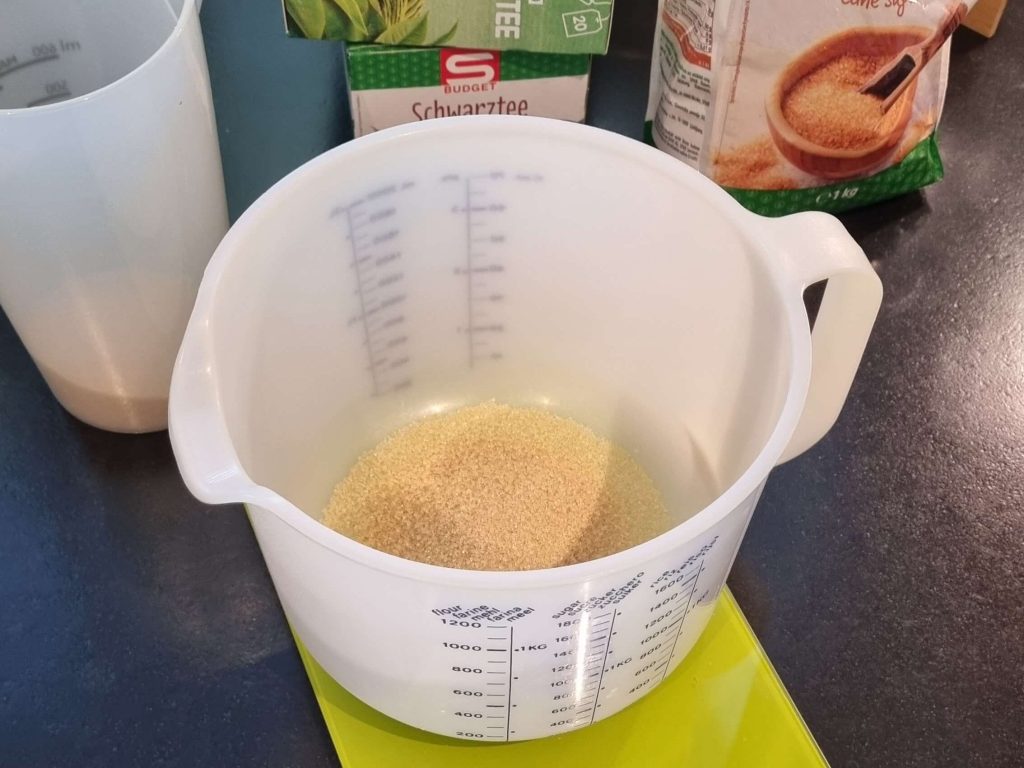
More sugar gives the yeast and bacteria more to work with, which can extend the period where the kombucha tastes sweet before it transitions to tangy. Less sugar means less to consume, potentially shortening the time to reach a tangy flavour. This also reduces how long the kombucha continues to develop before it runs out of fuel.
Batch size and jar shape
Larger batches in tall, narrow jars can ferment slightly differently than smaller batches in wide, shallow jars due to surface area to volume ratio. The SCOBY needs surface contact with both air and liquid. In practice, this effect is minor compared to temperature, but it’s part of why two people following the same recipe can get different results.
A Realistic Timeline
Here’s what to expect day by day in a kitchen around 22–24°C:
Days 1–2: Nothing visibly happens. This is normal. The culture is adjusting to the new sweet tea.
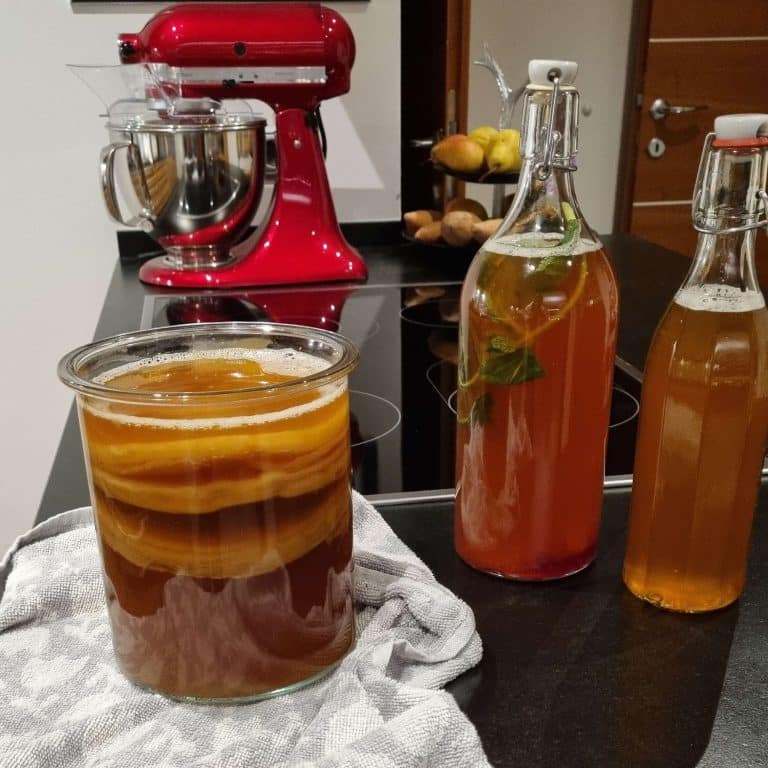
Days 3–4: A thin new SCOBY layer may begin forming on the surface. Small bubbles may appear around the edges. The smell starts to shift from sweet tea toward something slightly tangy.
Days 5–6: The new SCOBY layer is more visible. The smell is noticeably more vinegar-like. The kombucha is still quite sweet if tasted now.
Days 7–9: This is when most batches start tasting genuinely like kombucha — tangy with noticeable residual sweetness. Start tasting daily from here.
Days 10–14: The flavour continues to shift toward more tangy and less sweet. Most batches reach their preferred flavour somewhere in this window.
Beyond day 14: The kombucha continues becoming more acidic. By this point, most brewers have either harvested or are deliberately making a more vinegar-forward batch.
This timeline shifts earlier in warm conditions and later in cool conditions, but the sequence of changes (sweet → tangy → sour) stays the same regardless of speed.
How to Tell When Yours Is Ready
Taste it. This is the only method that actually matters. From day 7, taste a small amount daily using a clean straw. Slide it past the SCOBY, cover the top with your finger, lift and taste.
What you’re looking for: A balance between sweetness and tang that you personally enjoy. Some people like it closer to the sweet end, still recognisably tea-like with a gentle tang. Others prefer it more towards the sour end, closer to a light vinegar.
There’s no universal “done.” Two people brewing the exact same batch might harvest on different days because their preferences differ — and both would be correct.
Smell is a secondary indicator. As fermentation progresses, the smell becomes increasingly vinegar-like. A strong vinegar smell with a sweet taste usually means it’s close. A strong vinegar smell with a sharp, sour taste usually means it’s at or past your ideal point.
Building Your Own Timeline
After three or four batches, most brewers develop a reliable sense of how long their specific setup takes. A simple way to speed this up:
Keep a basic note for each batch: start date, approximate kitchen temperature, and the date you harvested along with a quick note on the flavour (“perfect,” “could have gone a day longer,” “slightly too sour”). After a few batches, patterns become obvious — you’ll start to know that your kitchen at its current temperature produces a batch you like around day 10, give or take a day depending on the season.
This is more useful than any fixed number because it’s specific to your conditions rather than someone else’s kitchen.
My own kitchen runs around 23°C most of the year and my batches consistently hit their sweet spot around day 10–11. In summer that drops to day 7-8. Knowing this took some batches to figure out.
What If You Forget About a Batch?
It happens to everyone eventually. A batch left for three or four weeks instead of the intended ten days isn’t dangerous. It’s simply more sour than intended, likely tasting strongly of vinegar. See my post on over-fermented kombucha for what to do with it. The short version: it makes excellent starter liquid and works well in cooking.
The SCOBY itself is generally fine after an extended fermentation, though you may notice it’s thinner or paler than usual if the sugar has been fully consumed for a long period. A subsequent batch with fresh sweet tea usually restores normal growth.
Second Fermentation Timing
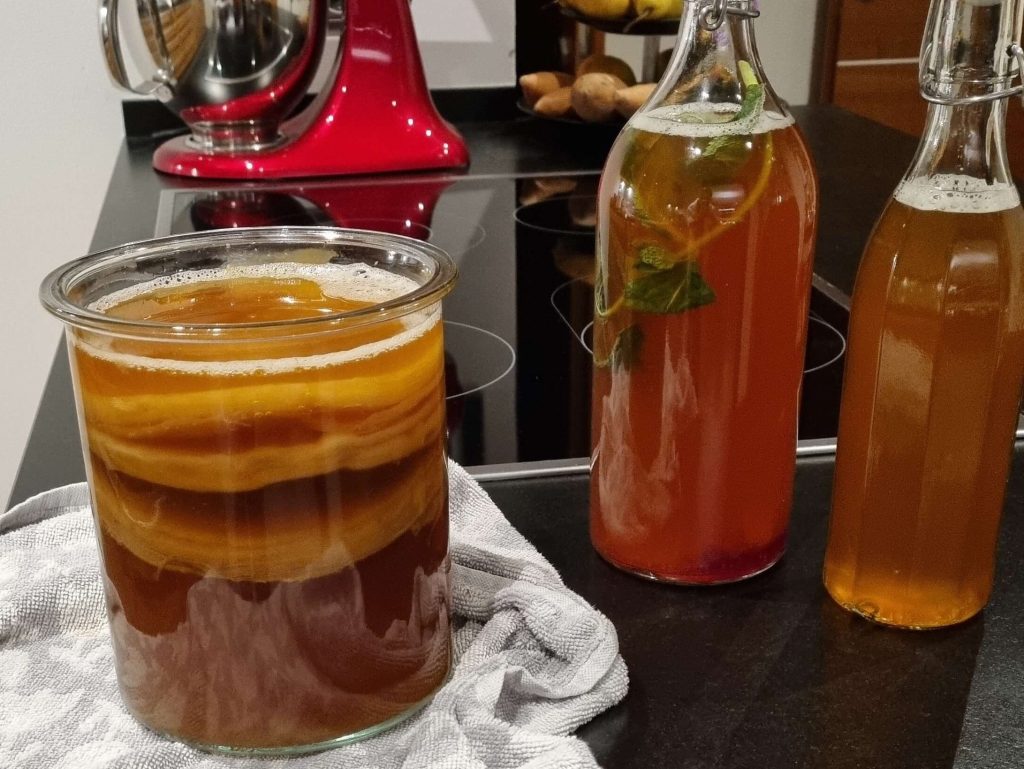
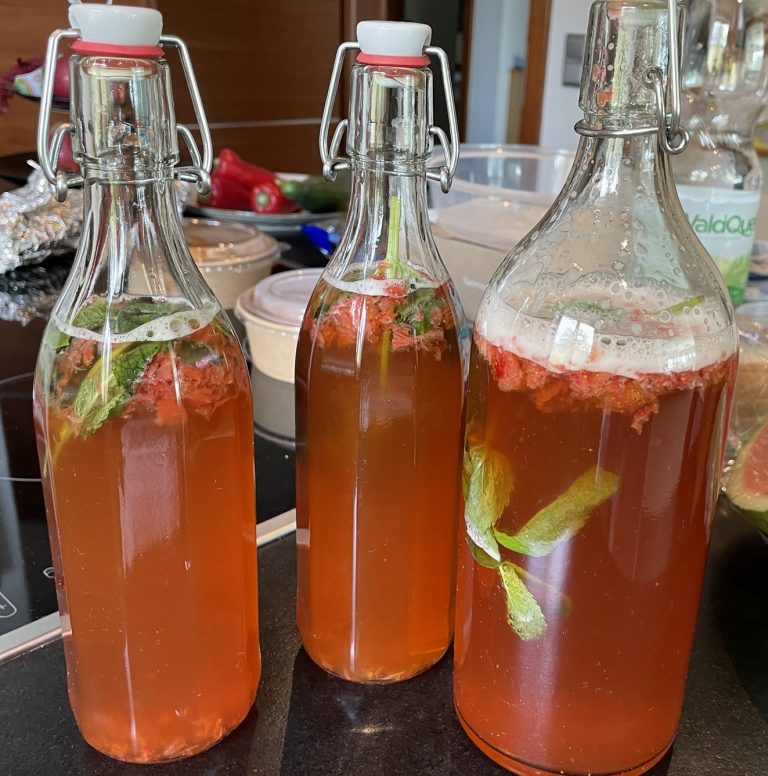
Second fermentation (the bottled, flavoured stage) follows a different timeline because it’s primarily about carbonation rather than flavour development.
2–4 days is typical at room temperature, with the exact time depending on temperature and how much natural sugar your chosen flavouring provides. Fruit with high natural sugar content — mango, blueberry, strawberry — tends to carbonate faster than drier additions like ginger alone.
Check daily from day 2 by opening the bottle just a crack over the sink. A strong hiss means it’s ready or close to ready. For more detail on troubleshooting carbonation specifically, see my post on why kombucha has no fizz.
Frequently Asked Questions
Can kombucha ferment too quickly?
Yes — in very warm conditions, (above 28°C) fermentation can complete in 5–6 days. While not dangerous, very fast fermentation at high temperatures can occasionally stress the culture. If your kitchen is consistently hot, taste from day 5 onwards.
Does fermentation time change as my SCOBY gets older?
Yes — a mature, well-established SCOBY often ferments more quickly and consistently than a new one. Your timing may shift during your first several batches as the culture settles in.
What happens if I leave kombucha to ferment for too long?
It becomes increasingly sour and eventually tastes like vinegar. It remains safe to drink and is excellent as starter liquid or in cooking. See my guide on over-fermented kombucha for details.
The Bottom Line
There’s no single correct fermentation time. There’s a range — roughly 7 to 14 days for first fermentation at typical room temperatures — and within that range, the right time for your batch is whenever it tastes the way you want it to taste.
The recipe gives you a starting point. Your palate gives you the actual answer. Taste from day 7, keep a few notes, and within a handful of batches you’ll have a much better sense of your own timeline than any single number could give you.
New to kombucha? My complete beginner’s guide to brewing kombucha at home covers the whole process from start to finish.
For the sweet tea ratios that affect fermentation timing, read my kombucha sweet tea guide.
Sources
Jayabalan, R., Malbaša, R. V., Lončar, E. S., Vitas, J. S., & Sathishkumar, M. (2014). A review on kombucha tea — microbiology, composition, fermentation, beneficial effects, toxicity, and tea fungus. Comprehensive Reviews in Food Science and Food Safety, 13(4), 538–550. https://doi.org/10.1111/1541-4337.12072
Crum, H., & LaGory, A. (2016). The big book of kombucha. Storey Publishing.