How to Make Kombucha Sweet Tea — The Exact Ratios I Use
Making sweet tea for kombucha sounds simple enough: brew some tea, stir in sugar, let it cool, and you’re done.
And honestly, it is pretty simple.
But after brewing kombucha for years, I’ve learned that getting the sweet tea right makes the whole process much more predictable. The type of tea you use, the amount of sugar you add, and even how you cool your tea can affect your finished kombucha.
In this guide, I’ll share the exact tea-to-sugar ratios I use for my own batches, how to adjust them for different batch sizes, and a few things I’ve learned through trial and error.
If you’re completely new to kombucha, I recommend starting with my complete beginner’s guide to brewing kombucha. Here, we’ll focus specifically on making the sweet tea.
The Basic Kombucha Tea-to-Sugar Ratio
For my usual batch, I use:
- 1 litre (1,000 ml) water
- 6 g black tea
- 4 g green tea
- 80–90 g raw cane sugar
- 200–300 ml mature starter kombucha
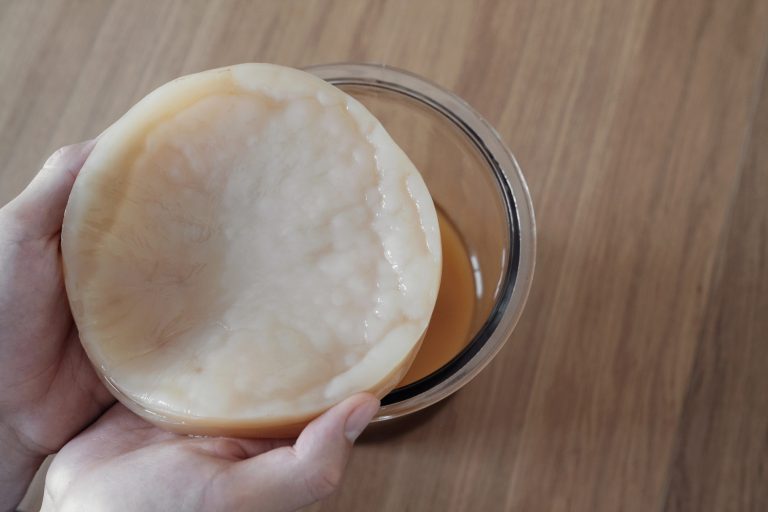
- 1 SCOBY pellicle (optional if you have enough active starter liquid)
That gives me approximately 1.2–1.3 litres of kombucha at the beginning of fermentation.
I usually brew in a 1.5-litre glass jar, so this leaves some space at the top.
My favourite combination is black and green tea, but if you’re just starting out, plain black tea and white granulated sugar are perfectly fine.
You don’t need expensive ingredients to make good kombucha.
A quick note about batch sizes: Throughout this article, the amount of water refers to the water used for brewing the sweet tea. The total batch volume also includes the starter kombucha you add afterwards.
This distinction matters because kombucha recipes don’t always define batch size in the same way.
Which Tea Is Best for Kombucha?

Black and green tea are both great options because they’re made from the tea plant, Camellia sinensis.
They provide compounds that influence the flavour and fermentation of kombucha, including polyphenols and other nutrients.
Research also shows that the type of tea, fermentation conditions, and microorganisms present can influence the chemical composition of the finished drink (Villarreal-Soto et al., 2018).
Black Tea
If you’re brewing your first batch, I’d recommend starting with plain black tea.
It produces a robust, full-bodied kombucha and is widely used in traditional kombucha brewing.
English Breakfast, Assam, or a simple supermarket black tea can all work well.
Some brewing guides make it sound like you need expensive loose-leaf tea, but in my experience, ordinary supermarket tea bags work perfectly fine.
Green Tea
Green tea produces a lighter, more delicate flavour.
I really like combining it with black tea because it gives the finished kombucha a slightly softer taste without losing the stronger tea character.
My usual combination is:
- 60% black tea
- 40% green tea
That’s 6 g black tea and 4 g green tea for my standard batch.
You can experiment with different proportions to find your favourite.
What About White Tea and Herbal Tea?
I’ve experimented with white tea as well, and I really enjoyed the flavour.
However, I noticed that my SCOBY pellicle developed differently when I used it. That doesn’t necessarily mean white tea is bad for kombucha. Pellicle growth can vary for several reasons, and my experience is just one observation.
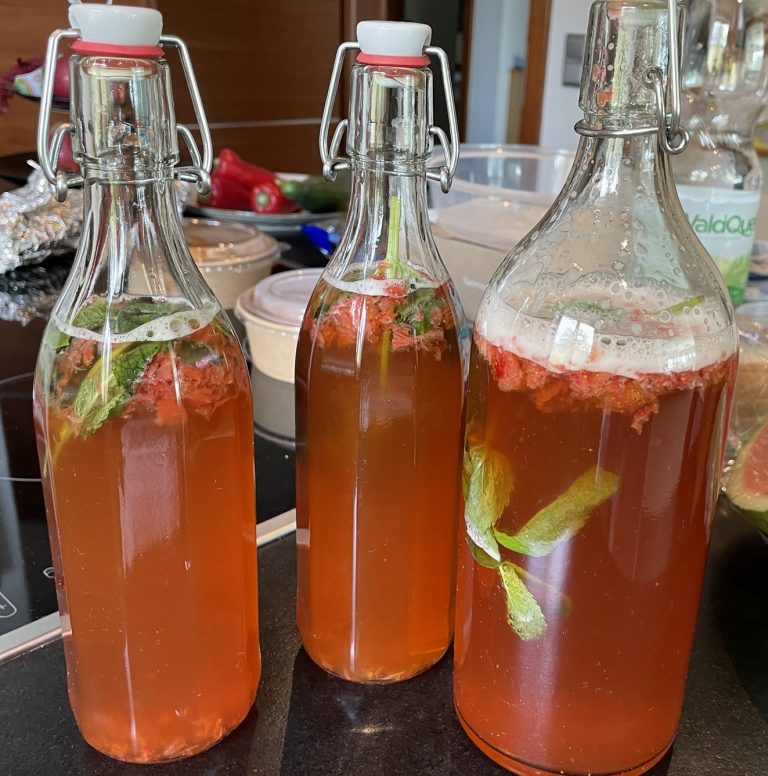
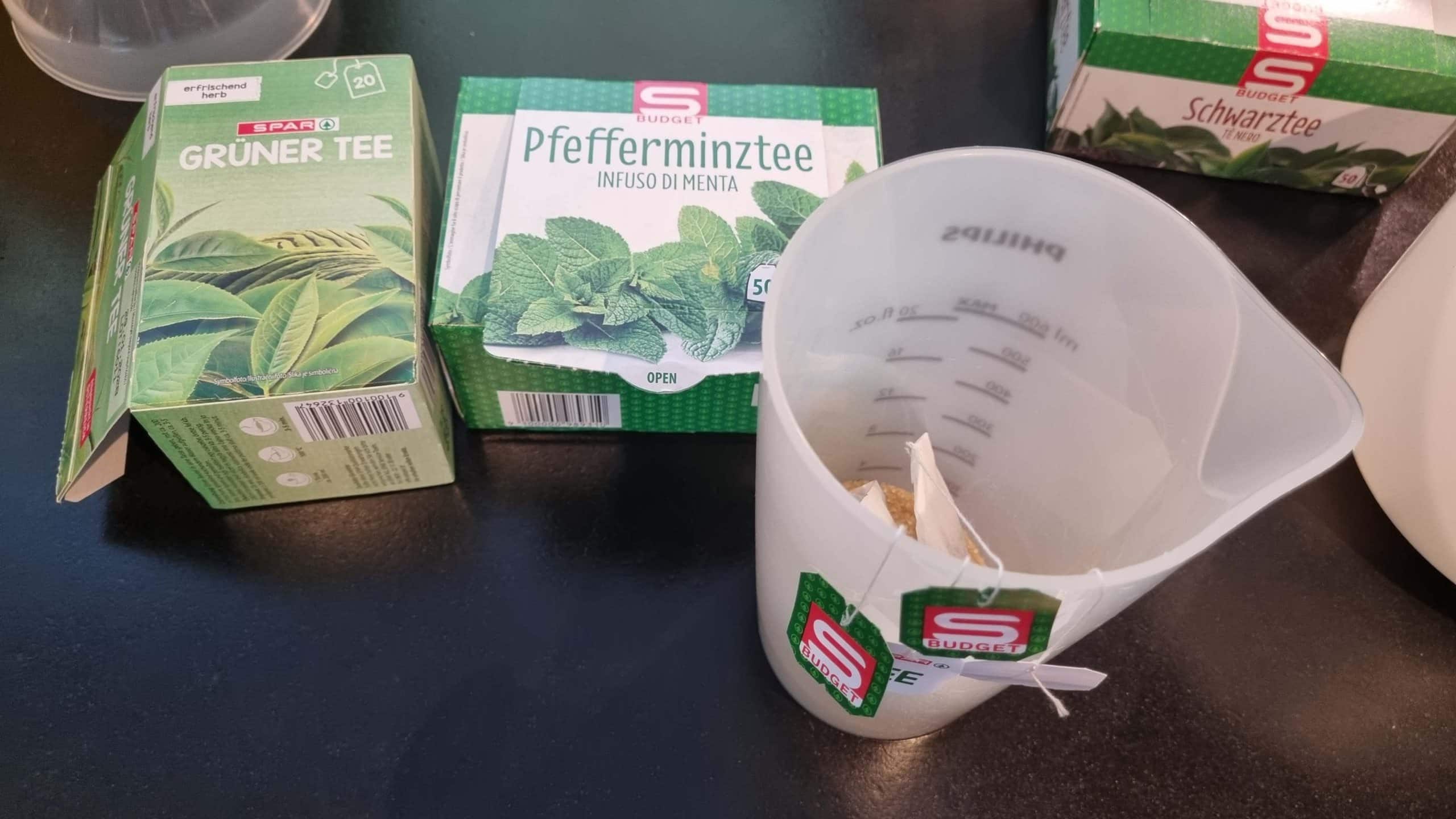
I also tried combining green tea with peppermint tea. It worked as an experiment, but I personally prefer adding fresh peppermint during the second fermentation. The flavour is much more noticeable that way.
Herbal infusions, fruit teas, and flavoured teas are something I’d approach more carefully, especially as a beginner.
Some contain added oils or ingredients whose effects on your particular kombucha culture aren’t well understood.
That doesn’t mean every flavoured tea will damage your SCOBY. But if you’re still learning how your culture behaves, plain black or green tea is the more predictable starting point.
Save the creative flavour combinations for your second fermentation, or experiment with a separate culture you don’t mind losing.
How Much Tea Do You Need for Kombucha?
For my standard batch, I use 10 g of dry tea per litre of brewing water.
That gives me a fairly strong tea base, which I enjoy in my finished kombucha.
You don’t necessarily need that much. Other kombucha recipes use less tea, and the ideal amount depends partly on the type of tea and the flavour you prefer.
If you’re using tea bags, check how much tea they contain.
A standard tea bag might contain around 1.5–2.5 g, but this varies between brands.
That’s why I prefer measuring tea in grams rather than counting bags. It makes my batches easier to compare.
How Long Should You Steep the Tea?
I usually steep my tea for around 10–15 minutes.
This produces a stronger infusion than I would normally make for drinking tea, but I like the results in kombucha.
Longer steeping can increase the extraction of compounds that contribute to bitterness and astringency, although the result depends on the type of tea and brewing temperature.
If your finished kombucha tastes too harsh, try adjusting your tea strength or steeping time.
And here’s a confession: I’ve forgotten to remove my tea bags more than once.
The kombucha still turned out fine.
So don’t panic if you accidentally steep your tea longer than planned. Just make a note of it and see how the batch develops.
I also recommend keeping a simple kombucha brewing diary. Recording your tea quantities, steeping time, fermentation temperature, and tasting notes makes it much easier to figure out what works best for you.
How Much Sugar Do You Need for Kombucha?

Sugar isn’t just there to make your tea sweet. It’s an important substrate for the microorganisms that ferment kombucha.
Yeasts can break down sucrose into glucose and fructose and metabolise these sugars. Acetic acid bacteria then use some of the resulting compounds, including ethanol, to produce organic acids.
Those acids help give kombucha its characteristic tart flavour.
For my batches, I use 80–90 g of sugar per litre of brewing water.
It’s a ratio that has worked consistently well with my culture.
Different recipes use different amounts, though, and there isn’t one universal sugar concentration that works best for every kombucha culture.
For example, Cohen et al. (2023) studied kombucha made with 50, 75, and 100 g sucrose per litre and found that sugar concentration and fermentation temperature influenced fermentation and sensory characteristics.
So while my ratio works for me, it isn’t the only way to make kombucha.
Does All the Sugar Disappear During Fermentation?
No, not necessarily.
Some sugar is consumed during fermentation, but the amount remaining depends on several factors, including your culture, temperature, fermentation time, and starting sugar concentration.
A kombucha that tastes much less sweet than the original tea can still contain residual sugar.
Longer fermentation often reduces sweetness and increases acidity, but that doesn’t mean the finished kombucha is automatically sugar-free.
If you’re interested in the science behind kombucha fermentation, the review by Jayabalan et al. (2014) is a useful place to start.
Which Sugar Should You Use?
White granulated sugar is a great choice for beginners.
It’s easy to measure, widely available, and commonly used in kombucha recipes and research.
Personally, I use raw cane sugar most of the time.
I like the flavour, and it has worked well with my culture. However, I wouldn’t claim that raw cane sugar is inherently better for fermentation.
Other sugar sources, such as coconut sugar or honey, can be used in some fermentation methods, but they may behave differently and aren’t necessarily interchangeable with ordinary sugar in an established recipe.
If you’re just getting started, I’d stick with white sugar until you’ve had a few successful batches.
Non-fermentable sweeteners such as stevia or erythritol aren’t suitable as a direct replacement for all the sugar in a standard kombucha recipe because they don’t provide the same fermentable substrate.
When Should You Add the Sugar?
I add the sugar while the freshly brewed tea is still hot.
Stir until it’s completely dissolved, then move on to cooling.
It’s a small step, but it makes preparing the sweet tea much easier.
Which Water Should You Use?
I usually use clean drinking-quality water for my kombucha.
Filtered water can be useful, particularly if your tap water has a strong chlorine taste or smell, but you don’t necessarily need to buy bottled water.
Ordinary tap water may work perfectly well depending on your local water supply.
One thing worth knowing is that chlorine and chloramine aren’t the same.
Letting water stand can help reduce free chlorine under suitable conditions, but it doesn’t reliably remove chloramine. If your water supplier uses chloramine and you want to remove it, you’ll need a treatment method designed for that purpose (US EPA, 2009).
For most home brewers, the practical starting point is simply to use safe drinking water and avoid unnecessary complications.
How to Make Sweet Tea for Kombucha: Step by Step
This is the method I use for almost every batch.
Step 1 — Heat Half the Water
Measure 500 ml of water and heat it in a clean pot or kettle.
I only heat half of my total water because it makes the cooling process faster later.
Step 2 — Steep the Tea
Remove the water from the heat and add:
- 6 g black tea
- 4 g green tea
Let the tea steep for around 10–15 minutes, then remove the tea leaves or bags.
If you’re using tea bags, there’s no need to squeeze them. I usually just lift them out.
Step 3 — Dissolve the Sugar
While the tea is still hot, add 80–90 g raw cane sugar.
Stir until the sugar has dissolved completely.
The liquid will be quite concentrated and sweet at this point, which is normal.
Step 4 — Add the Remaining Water
Add the remaining 500 ml of cool drinking water.
This helps bring the temperature down much faster than waiting for a full litre of hot tea to cool naturally.
You can also place the pot in a cold-water bath if you’re in a hurry.
Step 5 — Let the Sweet Tea Cool
Before adding your starter kombucha, let the tea cool to room temperature.
I aim for around 20–25°C (68–77°F).
Hot tea can stress or damage the microorganisms in your culture, so this isn’t a step I’d rush.
If you’re unsure about the temperature, a kitchen thermometer is useful.
Step 6 — Add the Starter Kombucha
Once the tea has cooled, transfer it into a clean brewing jar and add 200–300 ml of mature, unflavoured starter kombucha.
I usually add my SCOBY pellicle as well.
Important: Starter liquid isn’t just there to introduce the culture. Its acidity also helps lower the initial pH of the sweet tea, reducing the risk of unwanted microbial growth.
The amount of starter alone doesn’t guarantee a safe initial pH. If you’re starting with a new or unfamiliar culture, follow a tested kombucha method and check the acidity with an appropriately calibrated pH meter.
For a home-brewing safety reference, Utah State University Extension recommends checking that the prepared mixture is below pH 4.5. Follow the safety guidance of your chosen tested recipe rather than relying on taste alone.
Never use visibly mouldy or spoiled starter kombucha.
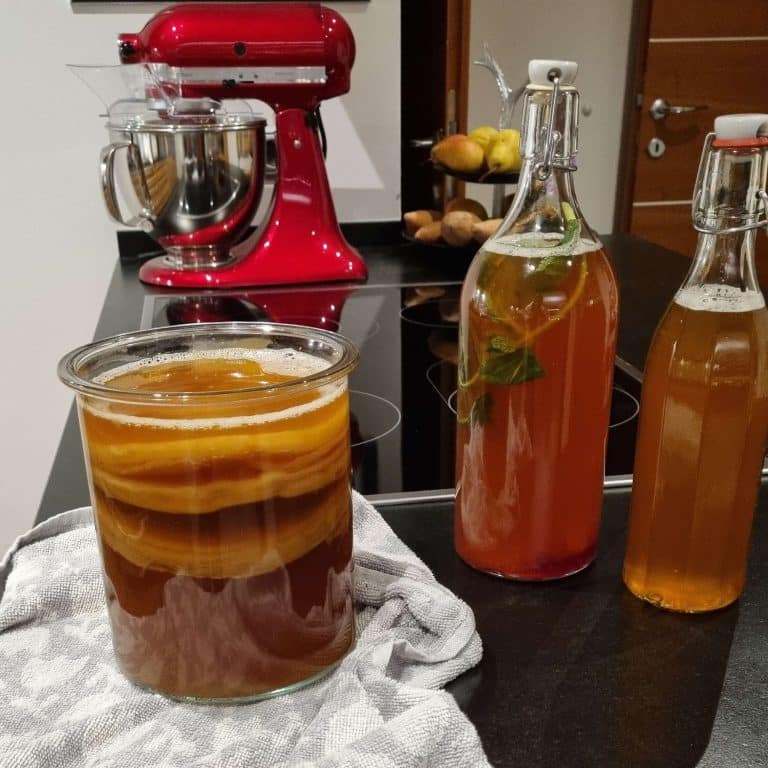
You can now cover your jar with a clean, tightly woven breathable cover, secure it against insects, and begin your first fermentation.
For the rest of the brewing process, see my complete kombucha brewing guide.
Kombucha Tea and Sugar Ratio Chart
If you want to make a smaller or larger batch, you can scale the ingredients using the same approximate proportions.
The table below follows my personal recipe.
| Total Batch Volume | Water | Starter Kombucha | Sugar | Dry Tea |
|---|---|---|---|---|
| 1 L | 800 ml | 200 ml | 64–72 g | 8 g |
| 1.3 L | 1,000 ml | 300 ml | 80–90 g | 10 g |
| 2 L | 1,600 ml | 400 ml | 128–144 g | 16 g |
| 3 L | 2,400 ml | 600 ml | 192–216 g | 24 g |
These are practical ratios based on my personal recipe, not universal fermentation requirements. Total volumes are approximate and exclude the space occupied by a pellicle. Use sufficiently acidic, active starter liquid and check the initial pH when appropriate.
For the tea, I use roughly 60% black tea and 40% green tea.
You can also start with plain black tea if you prefer.
For different batch sizes, make sure your fermentation jar is large enough to leave some headspace at the top.
How Sweet Tea Affects the Final Kombucha
One of the things I enjoy most about brewing kombucha is how much you can change the result with relatively small adjustments.
A stronger black tea base can create a fuller, more robust flavour, while a green tea blend may taste lighter.
The amount of sugar and the fermentation temperature can also affect how the finished kombucha develops.
And then there’s the culture itself. No two home-brewing cultures are necessarily identical, so the same recipe won’t always produce exactly the same result in every kitchen.
That’s why I prefer keeping my basic tea and sugar ratios consistent.
If I change too many things at once, it’s much harder to understand what made the difference.
Once you’re comfortable with your usual recipe, try changing one variable at a time and see what happens.
Common Sweet Tea Mistakes to Avoid
Adding Starter Kombucha While the Tea Is Still Hot
Always allow the sweet tea to cool before adding your live culture.
A kitchen thermometer makes this easier, especially when you’re preparing a larger batch.
Using Too Little or Weak Starter Liquid
Your starter kombucha should be mature, active, and sufficiently acidic.
A newly formed pellicle doesn’t replace the need for good starter liquid.
If you’re unsure whether your culture is ready, check the pH and follow a tested brewing method rather than simply adding extra sugar.
Changing Too Many Ingredients at Once
Trying a new tea, changing the sugar, and adjusting the fermentation temperature in the same batch can make troubleshooting difficult.
I recommend changing one thing at a time.
Using Strongly Flavoured Tea Too Early
Plain black or green tea makes it easier to build a consistent brewing routine.
Once you have a reliable culture, you can experiment with other ingredients in a separate batch.
Forgetting to Record Your Recipe
This one is easy to overlook.
You might remember exactly how you made your last batch today, but two weeks from now? Maybe not.
Even a few notes on your phone can make a big difference.
Frequently Asked Questions
What Is the Best Tea-to-Sugar Ratio for Kombucha?
For my usual recipe, I use 10 g of dry tea and 80–90 g of sugar per litre of brewing water, plus 200–300 ml of mature starter kombucha.
Other recipes use different concentrations, so treat this as a practical starting point rather than a universal rule.
How Much Sugar Do I Need for 1 Litre of Kombucha?
It depends on whether you mean one litre of brewing water or one litre of total kombucha.
For one litre of sweet-tea water, I use 80–90 g of sugar.
For a batch with approximately one litre of total volume, including 200 ml starter liquid, my scaled recipe uses 800 ml water and 64–72 g sugar.
Can I Use Decaffeinated Tea?
Decaffeinated black or green tea may be used, but its composition can differ depending on how it was processed.
If you’re changing to decaf, I’d recommend testing it with a smaller, separate batch rather than changing your main culture immediately.
Can I Reduce the Amount of Sugar?
You can experiment with lower sugar concentrations, but reducing sugar changes the conditions available to your culture.
It’s important to remember that using less sugar at the beginning doesn’t necessarily guarantee a low-sugar finished drink.
For reliable results, start with a tested recipe and make gradual changes while monitoring acidity and fermentation.
Final Thoughts
Making sweet tea for kombucha doesn’t need to be complicated. Once you find a ratio that works for your culture, sticking with it makes brewing much more predictable.
For me, that’s 1 litre of water, 10 g of tea, 80–90 g of raw cane sugar, and 200–300 ml of starter kombucha. It’s a simple, reliable base that lets me focus on experimenting with different flavours during the second fermentation.
If you’re new to kombucha, start with plain tea and sugar, measure your ingredients, and pay attention to how your batches develop. Once you’ve got the basics down, there’s plenty of room to experiment!
Ready for the next step? Head over to my complete kombucha brewing guide to learn about the first fermentation, or visit my kombucha troubleshooting guide if something isn’t going quite as planned.
Sources
Cohen, G., Sela, D. A., & Nolden, A. A. (2023). Sucrose concentration and fermentation temperature impact the sensory characteristics and liking of kombucha. Foods, 12(16), 3116. https://doi.org/10.3390/foods12163116
Jayabalan, R., Malbaša, R. V., Lončar, E. S., Vitas, J. S., & Sathishkumar, M. (2014). A review on kombucha tea—Microbiology, composition, fermentation, beneficial effects, toxicity, and tea fungus. Comprehensive Reviews in Food Science and Food Safety, 13(4), 538–550. https://doi.org/10.1111/1541-4337.12073
Villarreal-Soto, S. A., Beaufort, S., Bouajila, J., Souchard, J.-P., & Taillandier, P. (2018). Understanding kombucha tea fermentation: A review. Journal of Food Science, 83(3), 580–588. https://doi.org/10.1111/1750-3841.14068
Colorado State University Extension. (Reviewed 2025). Understanding and Making Kombucha. https://extension.colostate.edu/resource/understanding-and-making-kombucha/
United States Environmental Protection Agency. (2009). How can I remove monochloramine from my drinking water? https://www.epa.gov/sites/default/files/2015-09/documents/how_can_i_remove_monochloramine_from_my_drinking_water.pdf