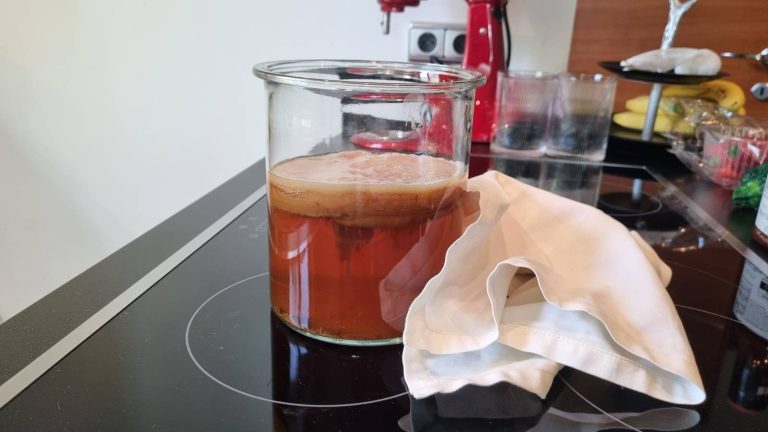

Why Your Kombucha Tastes Like Vinegar (And What to Do About It)
You taste your kombucha after ten days, and it hits you immediately — sharp, pungent, unmistakably vinegary. Not the pleasant tang you were hoping for. Something closer to salad dressing.
The good news is that this is one of the most common things that happens to home brewers and one of the easiest to understand. Over-fermented kombucha tastes like vinegar because it essentially is becoming vinegar. The same biological process that produces wine vinegar or apple cider vinegar is at work in your jar, just with tea as the base.
The better news is that the batch isn’t ruined. Over-fermented kombucha is still safe to drink, still useful, and actually excellent for certain purposes. And preventing it next time is straightforward once you understand what caused it.
Why Kombucha Tastes Like Vinegar

During fermentation, the bacteria in your SCOBY convert alcohol (produced by the yeast) into acetic acid — the same organic acid that gives vinegar its characteristic sharpness (Jayabalan et al., 2014).
In a well-timed batch, this process produces a pleasant balance: enough acidity to give kombucha its tang without tipping into something overwhelming. When fermentation runs too long, the acetic acid continues to build until it dominates the flavour entirely.
The result is kombucha that tastes like vinegar because chemically it’s moving in that direction. Left long enough — weeks rather than days — it would eventually become a genuine kombucha vinegar.
The Most Common Causes
1. Fermentation ran too long
This is the most straightforward cause. Every extra day at fermentation temperature means more acid production. A batch left for 14 days in a warm kitchen will almost always be more sour than the same batch harvested at day 9.
The fix going forward is simple: taste your kombucha regularly from day 7 and harvest when it reaches your preferred balance. Don’t leave it on the counter and forget about it.
2. The temperature was too high
Warmer temperatures accelerate fermentation significantly. A batch that takes 10–12 days to reach the right flavour in a cool kitchen can be over-fermented in 5–6 days in a hot summer kitchen. If your kitchen runs above 26°C in summer, start tasting from day 5.
This is one of the reasons keeping a basic brewing diary helps — noting the temperature alongside the fermentation time makes it much easier to predict when your next batch will be ready.
3. Too much starter liquid
Starter liquid is already acidic. Adding more than needed at the start of a batch gives it a head start on acidity that can tip the finished kombucha into overly sour territory, especially if fermentation also runs long.
100–300ml of starter liquid per litre is the right range. Going above 300ml without reducing fermentation time accordingly can produce a batch that’s already quite sour before fermentation has even done much work.
4. A very active SCOBY
A healthy, well-established SCOBY ferments more vigorously than a new or weakened one. If you’ve been brewing for a while and your SCOBY is large and well-fed, it will work through the available sugar faster than the same recipe would have in your first few batches. Shorten your fermentation time as your culture matures.
5. The jar was left in a very warm spot
Even within a room, temperature varies. A jar sitting directly beside the oven, above a radiator, or in a spot that gets afternoon sun can ferment significantly faster than one on the other side of the kitchen. If you’ve had consistently sour batches, check whether your brewing spot is warmer than you think.
What to Do With Over-Fermented Kombucha
This is the part most guides skip — over-fermented kombucha is genuinely useful, and there’s no reason to pour it down the sink.
Use it as starter liquid
This is the most practical use. Over-fermented kombucha is highly acidic, which makes it excellent starter liquid for your next batch. Its acidity will protect the new batch during the vulnerable early days of fermentation. Use 150–300ml per litre of sweet tea and your next batch will be off to a strong, well-protected start.
Use it in cooking
Kombucha vinegar is a real thing, and it’s genuinely good. Use your over-fermented kombucha anywhere you’d use apple cider vinegar:
- Salad dressings — particularly good with olive oil, mustard and honey
- Marinades for chicken or fish
- Deglazing a pan after cooking meat
- Pickling vegetables — quick pickles made with kombucha vinegar have a more complex flavour than those made with plain vinegar
- A splash in soups or stews for acidity
The flavour is more complex than commercial vinegar since it carries the tannins and subtle notes of the tea base. Some brewers intentionally make kombucha vinegar by leaving batches to ferment for weeks.
Dilute it
If the vinegar taste is present but not overwhelming, try diluting the over-fermented kombucha with fresh finished kombucha from a better-timed batch. A 50/50 mix often produces a perfectly pleasant result, and nothing goes to waste.
Use it for second fermentation anyway
Even quite sour first ferment kombucha can produce a decent second ferment, especially with fruit that adds sweetness. The high acidity just means the finished bottled kombucha will be on the tart side. For some combinations — ginger lemon especially — this actually works well.
How to Prevent It Next Time
Taste from day 7. Use a clean straw to taste directly from the jar without disturbing the SCOBY. Slide it under the SCOBY, cover the top with your finger, lift out and taste. Harvest when it reaches the balance you want — usually when it’s tangy but still has a hint of sweetness.
Keep a basic brewing diary. Note the date you started, the temperature of your brewing spot, and the date you harvested. After three or four batches, you’ll have enough data to predict when your next batch will be ready without relying entirely on daily tasting.
Shorten the fermentation time. If your last batch was too sour, reduce the next one by two or three days. It’s easier to leave a slightly sweet batch for another day than to un-sour an over-fermented one.
Watch the temperature in summer. Check your brewing spot with a thermometer if you haven’t already. A few degrees difference can mean two or three days difference in fermentation time. In a hot summer kitchen, batches can be ready in five or six days rather than ten.
Don’t use too much starter liquid. Stay within the 100–200ml per litre range unless you’re deliberately trying to speed up fermentation, in which case shorten the fermentation time to compensate.
How Sour Is Too Sour?
This is genuinely personal. Some brewers prefer kombucha on the tart side — close to vinegar but with more complexity. Others want something lighter and sweeter. Neither is wrong.
The practical question is whether the kombucha has passed the point where you enjoy drinking it. If it’s unpleasantly sharp rather than pleasantly tangy, it’s gone too far for drinking straight. That doesn’t mean it’s wasted — see the uses above.
A useful reference point: well-fermented kombucha typically has a pH between 2.5 and 3.5 (Jayabalan et al., 2014). Kombucha that tastes overwhelmingly of vinegar is probably sitting below 2.5, where most of the residual sweetness has been consumed, and the acidity dominates. pH strips can help you calibrate what different acidity levels taste like if you want to get precise about it.
Frequently Asked Questions
Is kombucha that tastes like vinegar safe to drink?
Yes — over-fermented kombucha is completely safe. It has simply produced more acetic acid than usual during a longer fermentation. The high acidity actually makes it less hospitable to harmful bacteria, not more. It may not be pleasant to drink straight, but it is not dangerous.
Can I fix kombucha that tastes like vinegar?
You cannot reverse the fermentation that has already happened, but you can dilute over-fermented kombucha with fresh finished kombucha from a better-timed batch. A 50/50 mix often produces a pleasant result. Alternatively, use it as starter liquid or in cooking.
How long does it take for kombucha to become too sour?
It depends on temperature and your SCOBY’s activity level. In a warm kitchen above 24°C, a batch can over-ferment in as few as 7–8 days. In a cooler kitchen below 20°C, it may take 14 or more days to reach the same point. Tasting from day 7 is the most reliable way to catch it at the right moment.
Can I use over-fermented kombucha as starter liquid?
Yes — it makes excellent starter liquid. Its high acidity provides strong protection for your next batch during the early days of fermentation when the culture is most vulnerable.
What should kombucha taste like when it’s ready?
Pleasantly tangy with a slight residual sweetness — similar to a tart apple juice with more complexity. There should be a noticeable acidity, but it should not be overwhelming. If it makes you wince rather than pucker slightly, it has gone too far.
One More Thing
The fact that your kombucha over-fermented isn’t a failure — it’s useful information. It tells you exactly where your batch went and gives you something precise to adjust next time. Every brewer over-ferments occasionally. The ones who get consistently good results are the ones who taste regularly, keep notes, and adjust rather than following a fixed timeline regardless of what the kombucha tells them.
Trust your palate. It’s the best fermentation tool you have.
Having trouble with fizz instead of sourness? Read my post on why kombucha has no fizz.
Want to understand what’s happening during first fermentation? My complete beginner’s guide covers the whole process.
For the exact sweet tea ratios that help you control fermentation timing, read my kombucha sweet tea guide.
Sources
Jayabalan, R., Malbaša, R. V., Lončar, E. S., Vitas, J. S., & Sathishkumar, M. (2014). A review on kombucha tea — microbiology, composition, fermentation, beneficial effects, toxicity, and tea fungus. Comprehensive Reviews in Food Science and Food Safety, 13(4), 538–550. https://doi.org/10.1111/1541-4337.12073
Crum, H., & LaGory, A. (2016). The big book of kombucha. Storey Publishing.