
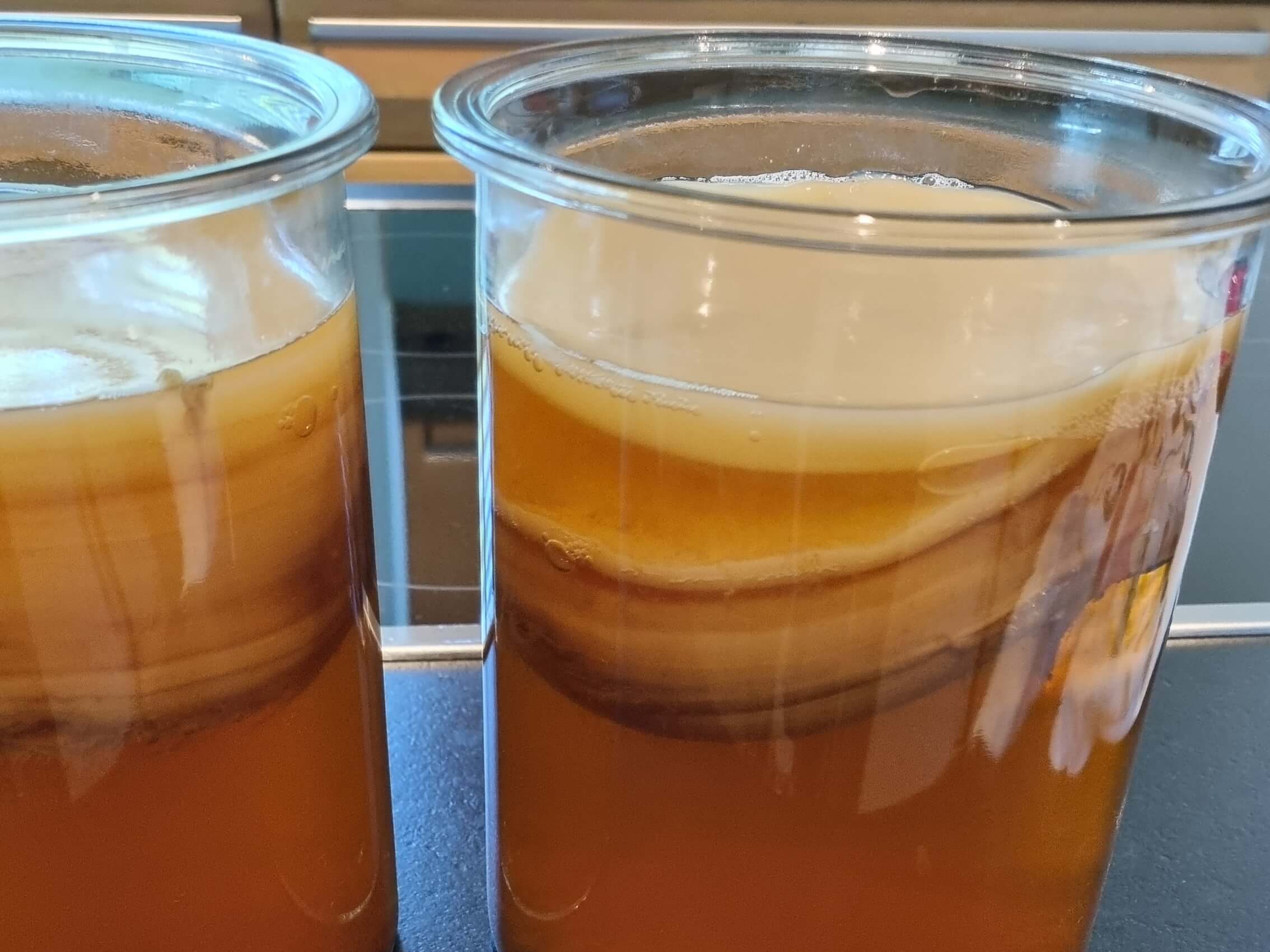
How to Build and Maintain a Kombucha SCOBY Hotel
After a few batches of kombucha you’ll notice something: your SCOBY is getting thicker. Every batch grows a new layer on the surface, and those layers fuse together over time into a disc that eventually becomes too thick to manage comfortably.
The solution is a kombucha SCOBY hotel — a jar where you store the spare layers you peel away, submerged in finished kombucha, kept alive and ready to use.
It sounds more complicated than it is. A SCOBY hotel is just a jar with some spare SCOBYs in it. But done properly it gives you a backup culture for every batch, a ready supply of SCOBYs to share with friends, and insurance against anything going wrong with your main brew.
This post covers everything: how to set one up, how to keep it healthy, and how to use it when you need it.
Why You Need a Kombucha SCOBY Hotel

Backup culture. If something goes wrong with a batch — mould, contamination, an accident — you have a healthy spare SCOBY ready to start again immediately rather than waiting weeks to source a new one.
Continuous supply. Every batch produces a new SCOBY layer. Without a hotel those layers pile up in your brewing jar until you have to throw them away. With a hotel they go somewhere useful.
SCOBYs to share. The kombucha community runs partly on gifted SCOBYs. A hotel gives you a permanent supply to pass on to anyone who wants to start brewing.
Starter liquid reserve. The liquid in your SCOBY hotel — finished, acidic kombucha — is excellent starter liquid. It’s often more acidic than your regular finished batch which makes it particularly effective at protecting new batches during early fermentation.
What You Need
- A large wide-mouth glass jar — at least 1 litre, larger if you brew regularly
- Spare SCOBY layers from your brewing jar
- Finished kombucha (starter liquid) to cover the SCOBYs completely
- A breathable cover — cloth or coffee filter
- A rubber band
That’s it. No special equipment needed beyond what you already use for brewing.
How to Set Up Your SCOBY Hotel
Step 1 — Choose your jar
Any large wide-mouth glass jar works. The size depends on how many spare SCOBYs you accumulate. A 1-litre jar is enough to start. A 2-litre jar gives you more room as the hotel grows over time.
Step 2 — Peel your spare layers
After your first few batches your SCOBY will have multiple fused layers. Peel away the oldest, darkest layers from the bottom — these are the least active. Keep the top two or three layers in your brewing jar and put the rest in the hotel.
For a detailed guide on what healthy and unhealthy SCOBY layers look like, read my SCOBY appearance guide.
Step 3 — Fill with starter liquid
Place the spare SCOBYs in the hotel jar and cover them completely with finished kombucha — either from your current batch or from previous batches. The liquid must cover all the SCOBYs fully. Any exposed SCOBY surface is vulnerable to mould.
Step 4 — Cover and store
Cover with cloth and secure with a rubber band — the same setup as your brewing jar. The hotel needs some airflow.
Store at room temperature or in the fridge. Room temperature keeps the culture more active. The fridge slows everything down and means less maintenance but the culture takes longer to reactivate when you need it.
How to Maintain Your SCOBY Hotel
A neglected SCOBY hotel becomes a problem. An actively maintained one stays healthy indefinitely.
Top it up regularly
The liquid level drops over time as the SCOBYs absorb it and some evaporates. Check every two to three weeks and top up with fresh finished kombucha to keep all SCOBYs fully submerged.
At room temperature check more frequently — every one to two weeks. In the fridge every three to four weeks is sufficient.
Remove old layers monthly

The hotel will grow new SCOBY layers just like your brewing jar. Peel away the oldest, darkest bottom layers monthly and compost them. Keep the jar from getting too full — overcrowding reduces the liquid to SCOBY ratio and can stress the culture.
Feed it occasionally
If the hotel sits for more than a month without fresh liquid added, the culture can weaken. Make a small batch of sweet tea (100–200ml), let it cool completely, and add it to the hotel alongside fresh finished kombucha. This gives the culture something to work with and keeps it active.
Check for mould
Every time you open the hotel check the surface of the liquid and the top of the uppermost SCOBY for any fuzzy growth. Flat dark patches are normal yeast activity. Fuzzy mould — green, black, pink or white — means discard the entire hotel contents and start again with a fresh culture. If anything on your SCOBY — mould aside — doesn’t match what’s described here or in my SCOBY health guide, my kombucha troubleshooting guide covers every common problem in detail, from taste issues to appearance concerns.
Room Temperature vs Fridge — Which Is Better?
Both work. The right choice depends on how often you brew and how much attention you want to give the hotel.
Room temperature:
- Culture stays active and responsive
- Ready to use immediately when needed
- Needs topping up every 1–2 weeks
- New SCOBY layers grow continuously
- Better for brewers who produce batches regularly
Fridge:
- Culture goes semi-dormant — much slower activity
- Needs topping up every 3–4 weeks
- Minimal new SCOBY growth
- Takes 1–2 batches to fully reactivate after a long cold rest
- Better for brewers who take breaks or brew infrequently
I keep mine at room temperature because I brew continuously and need the hotel liquid as starter liquid regularly. If you take breaks from brewing for weeks at a time the fridge is more practical.
Using Your SCOBY Hotel
Taking a SCOBY from the hotel
When you need a fresh SCOBY — for a new brewing jar, to give to someone, or to replace a damaged culture — simply lift one out with clean hands. The liquid that comes with it is your starter liquid for the new batch.
A SCOBY that has been in the hotel for a while may be paler and thinner than your main brewing SCOBY. This is normal — it will build up thickness again over successive batches in the brewing jar.
Using the hotel liquid as starter
The liquid in a well-maintained SCOBY hotel is often more acidic than regular finished kombucha, which makes it excellent starter liquid. Use it as you would any other starter liquid — 200–300ml per litre of sweet tea.
Restarting after a break
If your hotel has been in the fridge for several weeks, bring it to room temperature 24 hours before you need it. The first batch after a long cold rest may ferment more slowly than usual as the culture reactivates. The second batch will typically be back to normal.
How Many SCOBYs Should You Keep?
There’s no fixed number — it depends on how much you brew and how much jar space you have. A practical approach:
Keep enough SCOBYs in the hotel to fill your brewing jar immediately if something went wrong with your main culture. For a 1-litre brewing jar that’s one good-sized SCOBY with enough liquid to cover it.
Beyond that backup supply, the rest is a matter of preference. Some brewers maintain large hotels with many layers — useful if you give SCOBYs away regularly or brew multiple jars at once. Others keep the minimum needed and compost the rest.
Don’t feel obliged to keep every SCOBY you produce. Composting healthy SCOBYs you don’t need is completely fine.
What to Do With Excess SCOBYs
SCOBYs reproduce faster than most brewers can use them. A few options beyond composting:
Give them away. Anyone curious about kombucha brewing is the obvious recipient. A SCOBY with 200-300ml of starter liquid in a clean jar is the perfect introduction to brewing.
Feed them to animals. Chickens and dogs are both happy to eat SCOBYs. The culture is harmless and nutritious for both.
Dehydrate them. SCOBYs can be dehydrated in a low oven or food dehydrator and stored for several months. A dehydrated SCOBY can be reactivated in sweet tea when needed — useful as a long-term backup that takes up minimal space.
Cook with them. There is a small but enthusiastic community of brewers who use SCOBYs in cooking — dehydrated into jerky-style snacks, blended into smoothies, used as a meat substitute in some preparations. The flavour is mild and slightly tangy. If you want to try this, search for SCOBY jerky or SCOBY cooking recipes from experienced brewers first — food safety and preparation methods vary, and it’s worth seeing how others approach it before experimenting yourself.
Frequently Asked Questions
How long can a SCOBY survive in a hotel?
Indefinitely if properly maintained. A well-fed, regularly topped-up SCOBY hotel can stay healthy for years. The key requirements are keeping the SCOBYs fully submerged in liquid, topping up regularly and removing old layers before the jar becomes overcrowded.
Can I store a SCOBY hotel in the fridge?
Yes — the fridge slows the culture down significantly but doesn’t harm it. A fridge-stored hotel needs topping up every three to four weeks rather than every one to two weeks. After a long cold rest allow one to two batches for the culture to fully reactivate.
What liquid should I use to fill the SCOBY hotel?
Finished kombucha from your regular brewing — the same liquid you would use as starter liquid for a new batch. It should be properly fermented and acidic. Sweet tea or plain water are not suitable as the only liquid in the hotel.
My SCOBY hotel smells very vinegary — is that normal?
A sharp, vinegary smell is completely normal and means the culture is active and acidic. A genuinely rotten or foul smell — different from sharp vinegar — is a warning sign worth investigating. Check for mould on the surface and discard if anything looks or smells wrong beyond normal fermentation sharpness.
How do I know when to throw away old SCOBY layers?
Peel and compost the oldest, darkest layers from the bottom of the hotel monthly regardless of how they look. Keep the newer, lighter layers on top. If any layer shows fuzzy mould growth discard it immediately and check the rest carefully.
The Short Version
A SCOBY hotel is a large jar with spare SCOBYs submerged in finished kombucha, covered with cloth, stored at room temperature or in the fridge. Top it up every few weeks, remove the oldest layers monthly, check for mould when you open it.
It takes five minutes to set up and five minutes of attention every few weeks to maintain. In return you always have a backup culture, a supply of excellent starter liquid, and SCOBYs to share whenever someone asks where to get one.
For everything you need to know about your SCOBY — what it is, how it works and what healthy looks like — read my complete SCOBY guide.
New to kombucha? Start with my complete beginner’s guide to brewing kombucha at home.
Sources
Jayabalan, R., Malbaša, R. V., Lončar, E. S., Vitas, J. S., & Sathishkumar, M. (2014). A review on kombucha tea — microbiology, composition, fermentation, beneficial effects, toxicity, and tea fungus. Comprehensive Reviews in Food Science and Food Safety, 13(4), 538–550. https://doi.org/10.1111/1541-4337.12073
Crum, H., & LaGory, A. (2016). The big book of kombucha. Storey Publishing.
